/NTT%20logo%20white%202025.svg "NTT logo white 2025")
Private 5G & IoT: The Power Duet Fuelling Hong Kong's Smart City Revolution
Abstract from NTT Innovation Summit’s panel discussion
“Orchestrating a New Era of Machine Interaction: The Duet of Private 5G & IoT”
30th October 2024
Don't just hear from human leaders,
challenge your mind with the perspectives of a social humanoid. Sophia, the HK-grown sensation, shares her unique insights on what truly fuels innovation.
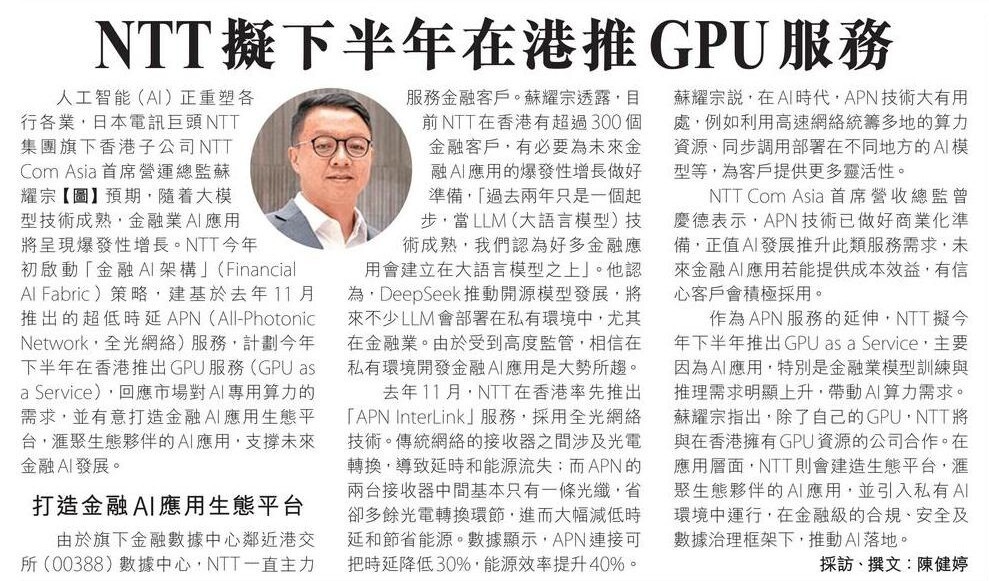
NTT Plans to Launch GPU Services in Hong Kong in the Second Half of the Year
Interview with Stephen Tsang, Chief Revenue Officer, NTT Com Asia; and Steven So, Chief Operating Officer, NTT Com Asia

/steven-so.png?width=134&height=150&name=steven-so.png)
Stephen Tsang
Chief Revenue Officer
NTT Com Asia
Steven So
Chief Operating Officer
NTT Com Asia
Artificial intelligence (AI) is reshaping industries across the board. Steven So, Chief Operating Officer of NTT Com Asia, the Hong Kong subsidiary of Japan’s telecommunications giant NTT Group, expects AI applications in the financial sector to see explosive growth as large language model (LLM) technologies mature.
Earlier this year, NTT launched its Financial AI Fabric strategy, building on the ultra‑low‑latency APN (All‑Photonics Network) service introduced in November last year. The company plans to roll out GPU as a Service in Hong Kong in the second half of this year to address growing market demand for AI‑dedicated computing power. NTT also aims to develop a financial AI application ecosystem platform, bringing together AI solutions from ecosystem partners to support the future development of financial AI.
Building a Financial AI Application Ecosystem
With its financial data centre located close to the Hong Kong Exchanges and Clearing (HKEX, 00388) data centre, NTT has long focused on serving financial clients. So revealed that NTT currently serves over 300 financial customers in Hong Kong, making it essential to prepare for the anticipated surge in financial AI applications.
“The past two years were only the beginning,” he said. “As LLM technologies mature, we believe many financial applications will be built on large language models.”
He noted that the rise of DeepSeek is accelerating the development of open‑source models, and that many LLMs will increasingly be deployed in private environments, particularly in the financial sector. Given the industry’s stringent regulatory requirements, developing financial AI applications in private environments is expected to become the prevailing trend.
In November last year, NTT was among the first to launch the APN InterLink service in Hong Kong, leveraging all‑optical network technology. Traditional networks involve optical‑electrical‑optical (O‑E‑O) conversions between transceivers, resulting in latency and energy loss. By contrast, APN connects two transceivers primarily through a single optical fibre, eliminating unnecessary conversion stages and significantly reducing latency while improving energy efficiency.
Data shows that APN connectivity can reduce latency by 30% and improve energy efficiency by 40%. So said that in the AI era, APN technology has broad applications—such as orchestrating computing resources across multiple locations via high‑speed networks, or synchronously invoking AI models deployed in different locations—offering customers greater flexibility.
Stephen Tsang, Chief Revenue Officer of NTT Com Asia, said APN technology is now fully ready for commercialisation, and with AI development driving demand for such services, he is confident customers will actively adopt financial AI applications if they deliver cost efficiency.
As an extension of its APN services, NTT plans to launch GPU as a Service in the second half of this year, driven by the sharp rise in AI computing demand—particularly for model training and inference in the financial sector. So added that, in addition to its own GPU resources, NTT will collaborate with companies that already have GPU capacity in Hong Kong.
At the application layer, NTT will build an ecosystem platform to aggregate AI solutions from ecosystem partners and deploy them in private AI environments, advancing AI adoption under a financial‑grade compliance, security, and data governance framework.
Learn more about All-Photonics Network
Empowering financial institutions to thrive in today’s fast-paced digital landscape, with ultra-low latency, high-capacity, and highly reliable network photonics-based connectivity.